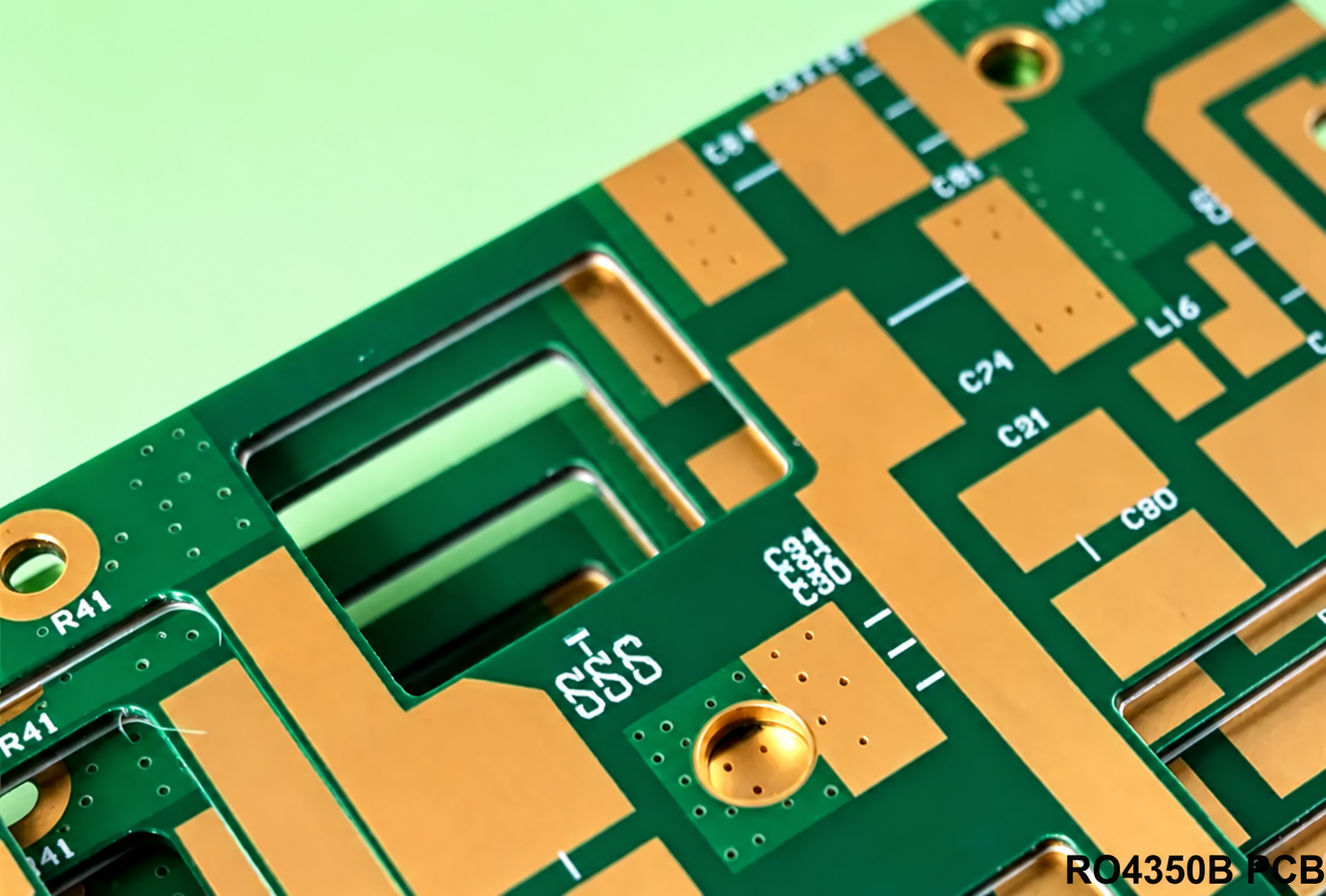
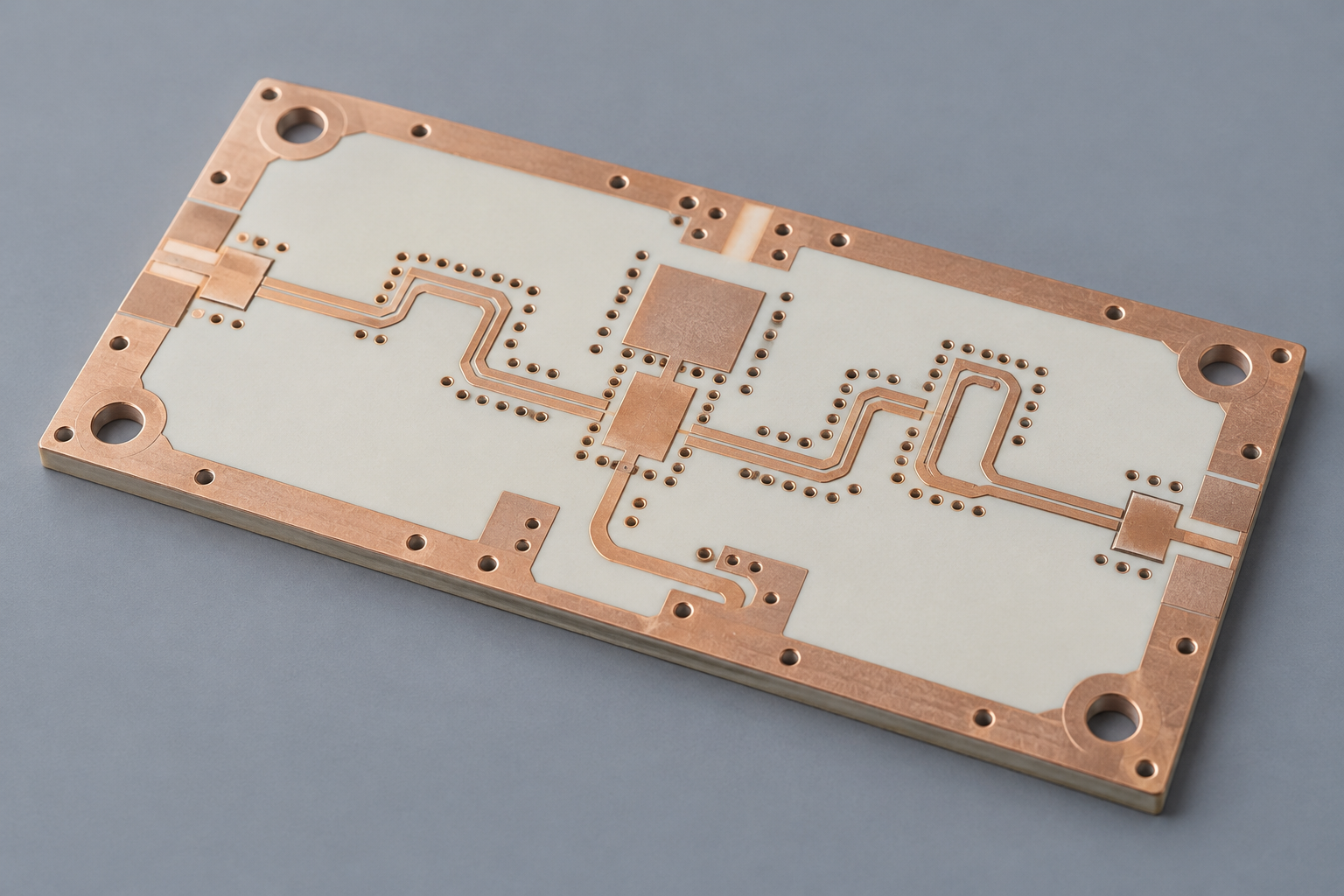
RF & Microwave Substrate

The Engineer's Guide to Rogers Ro4350b PCB

Complete technical reference for designers working with Rogers RO4350B — covering dielectric constant, impedance design, White Tin finish, manufacturing tolerances, and high-frequency applications from 1 GHz to 77 GHz.

RO4350B Quick Reference · Rev D
Dielectric Constant (Dk) @ 10 GHz 3.48 ±0.05
Dissipation Factor (Df) @ 10 GHz 0.0037
Thermal Coeff. of Dk (TCDk) +50 ppm/°C
Thermal Conductivity 0.69 W/(m·K)
CTE (x, y / z axis) 14 / 50 ppm/°C
Tg (Glass Transition) > 280°C
Surface Resistivity 4.2×10⁹ MΩ/sq
RoHS Compliant ✓ Yes
View Full Datasheet & Order →
Dielectric Properties

Rogers RO4350B Material Specifications

RO4350B is a hydrocarbon ceramic laminate engineered for stable Dk across a wide frequency range — critical for predictable impedance in high-frequency designs above 500 MHz.

3.48
Dk @ 10 GHz
Dielectric Constant
±0.05 tolerance
📉
0.0037
Df @ 10 GHz
Dissipation Factor
Low-loss RF performance
🌡️
>280°C
Tg
Glass Transition Temp
Lead-free solder compatible
🔥
0.69
W/(m·K)
Thermal Conductivity
Better than PTFE laminates
Property Value Unit Test Condition Standard
Dielectric Constant (Dk)3.48 ±0.0510 GHz / 23°CIPC-TM-650 2.5.5.5
Dissipation Factor (Df)0.003710 GHz / 23°CIPC-TM-650 2.5.5.5
Thermal Coeff. of Dk+50ppm/°C−50 to +150°CIPC-TM-650 2.5.5.5
Dimensional Stability<0.5 / <0.5mm/mafter etch x/yIPC-TM-650 2.4.39
Coefficient of Thermal Expansion (x)14ppm/°C−55 to +288°CIPC-TM-650 2.4.41
Coefficient of Thermal Expansion (y)16ppm/°C−55 to +288°CIPC-TM-650 2.4.41
Coefficient of Thermal Expansion (z)50ppm/°C−55 to +288°CIPC-TM-650 2.4.41
Thermal Conductivity0.69W/(m·K)ASTM E1461
Glass Transition Temperature (Tg)>280°CTMAIPC-TM-650 2.4.24
Decomposition Temperature (Td)390°CTGAIPC-TM-650 2.4.24.6
Peel Strength (1 oz Cu)1.1N/mmafter thermal stressIPC-TM-650 2.4.8
Volume Resistivity1.7×10⁹MΩ·cmIPC-TM-650 2.5.17
Surface Resistivity4.2×10⁹MΩ/sqIPC-TM-650 2.5.17
Dielectric Breakdown31.2kV/mmASTM D149
Parameter RO4350B RO4003C FR4 (standard) PTFE (Rogers RT/duroid)
Dk @ 10 GHz3.48 ±0.053.55 ±0.054.2–4.8 (variable)2.2–2.94
Df @ 10 GHz0.00370.00270.018–0.0250.0009–0.002
Tg>280°C>280°C130–170°CN/A (thermoset)
CTE z-axis50 ppm/°C46 ppm/°C70 ppm/°C24 ppm/°C
Dk Stability vs FreqExcellentExcellentPoorGood
Dk Stability vs TempExcellentExcellentPoorGood
Water Absorption0.06%0.06%0.10%<0.02%
Standard PCB ProcessYes (like FR4)Yes (like FR4)YesNo (special process)
Relative Cost (2-layer)3–5×FR43–5×FR4Base8–15×FR4
Max Freq. Recommendation77 GHz+77 GHz+≤1 GHz100+ GHz
Core Thickness Tolerance Common Copper Weight Typical Z0 (50Ω microstrip) Application Notes
0.101 mm (4 mil)±0.013 mm0.5 oz, 1 oz~1.3 mm tracemmWave, 60–77 GHz
0.168 mm (6.6 mil)±0.013 mm0.5 oz, 1 oz~2.2 mm trace5G sub-6 GHz to 30 GHz
0.254 mm (10 mil)±0.025 mm0.5 oz, 1 oz, 2 oz~3.4 mm traceMost popular – 5–20 GHz
0.508 mm (20 mil)±0.038 mm1 oz, 2 oz~6.8 mm tracePower amplifiers, 1–10 GHz
0.762 mm (30 mil)±0.064 mm1 oz, 2 oz~10.2 mm traceHigh-power RF, base station
1.524 mm (60 mil)±0.099 mm1 oz, 2 oz~20.5 mm traceLow-freq RF, hybrid boards
Engineering Tools

Rogers Ro4350b Impedance Calculator

Calculate microstrip and stripline characteristic impedance using RO4350B's measured Dk of 3.48. Results are based on the IPC-2141A and Hammerstad–Jensen models.

Microstrip Z₀ Calculator RO4350B

Dk locked to 3.48 (Rogers RO4350B @ 10 GHz). Adjust trace geometry to find 50Ω.

Trace Width (W) 1.00 mm
Substrate Height (H) 0.508 mm
Copper Thickness (T) 0.035 mm
Frequency (GHz)
Dk (locked)
Characteristic Impedance Z₀
Ω
Enter parameters above and click Calculate
Target 50Ω hint
For 20 mil (0.508 mm) RO4350B with 1 oz Cu: W ≈ 1.08 mm gives ~50Ω. Use W ≈ 2.20 mm for 40 mil (1.0 mm) substrate.
Effective Dk (εeff)
Calculated effective dielectric constant will appear here after computation.
Cross-Section Diagram · RO4350B Microstrip
W (trace width) H RO4350B εr = 3.48 | tan δ = 0.0037 Ground Plane (Cu) Signal Trace E-field T RESULT —Ω εeff = — SUBSTRATE Rogers RO4350B
λ/4 Length
Quarter-wave stub
Phase Velocity
×10⁸ m/s
Wavelength (λ)
in substrate
Eff. Dk (εeff)
effective permittivity
Fabrication Guide

Manufacturing Rogers Ro4350b PCB

RO4350B processes on standard FR4 equipment — no special tooling required. These guidelines ensure yield and dimensional accuracy for RF designs.

1. Material Handling & Storage
Pre-process
Store RO4350B panels in a dry, temperature-controlled environment (15–30°C, <60% RH). Avoid stacking without protective interleave. No pre-bake required under normal conditions — a key advantage over PTFE laminates.
Inspect for delamination at incoming QC. RO4350B is dimensionally very stable.
2. Inner Layer Imaging & Etching
Critical
Use fine-line dry film resist. RO4350B etches cleanly with standard acid copper etchants (cupric chloride or ammonium persulfate). Maintain tight process controls: trace width tolerance ±0.025 mm is achievable. Dk variation is far less sensitive to etch uniformity than FR4.
Trapezoidal trace cross-section will slightly lower effective Dk — account for this at mmWave.
3. Drilling & Hole Quality
RF Critical
RO4350B drills well with standard carbide bits at standard FR4 parameters — no specialty drill bits needed. Use low-halogen drill entry material. Maintain chip load within spec. Epoxy desmear compatible. For RF vias, back-drill to minimize stub effects at frequencies above 10 GHz.
Back-drilling critical for signal integrity above 10 GHz. Specify drill diameter tolerance ±0.05 mm.
4. Lamination (Multilayer)
Temperature
RO4350B bonds well with standard glass-reinforced prepregs and Rogers RO4450F bondply. Peak lamination temperature: 190–210°C at 250–400 psi. Excellent dimensional stability during lamination due to the ceramic filler system — critical for impedance matching across the panel.
Rogers RO4450F prepreg recommended for hybrid builds with RO4350B cores.
5. Plating & Surface Finish
White Tin / ENIG
Electroless copper and panel/pattern plating follow standard FR4 procedures. Surface finish options: Immersion Tin (White Tin), ENIG, ENEPIG, OSP, HASL (lead-free). For RF applications, Immersion Tin (White Tin) is widely preferred — flat, co-planar, excellent solderability, no gold intermetallic concerns.
White Tin (Immersion Tin) is the leading choice for Rogers Ro4350b PCB RF boards.
6. Soldermask & Legend
Optional
Standard LPI (Liquid Photo-Imageable) soldermask is compatible. For bare RF circuits (e.g., antenna arrays, filter boards), soldermask may be omitted to prevent Dk variation from mask material on exposed traces. When used, match soldermask thickness carefully — it will raise effective Dk of exposed microstrip slightly.
Multilayer RO4350B Stackup Example · 4-Layer
L1 · Signal · 1 oz Cu (35μm) RO4350B Core εr=3.48 | 0.254mm (10mil) L2 · Ground Plane · 1 oz Cu RO4450F Bondply εr=3.52 | 0.100mm (4mil) L3 · Power Plane · 1 oz Cu RO4350B Core εr=3.48 | 0.254mm (10mil) L4 · Signal / GND · 1 oz Cu Soldermask Soldermask ~0.74mm total SURFACE FINISH Immersion Tin (White Tin)
Lead-Free Solder Compatible
Tg >280°C ensures RO4350B survives multiple lead-free reflow cycles (peak 260°C) without delamination or Dk shift.
CAF Resistance
Superior conductive anodic filament (CAF) resistance due to the thermoset resin system — important for fine-pitch designs.
Impedance Tolerance
Achievable controlled impedance tolerance: ±5% (standard) or ±3% (premium). Tight Dk tolerance (±0.05) is key.
Panelization
Standard panel sizes: 18"×24", 12"×18". Custom sizes available. Routed, V-scored, or tab-routed depanelization.
Surface Finish

White Tin (Immersion Tin) for Rogers Ro4350b PCB

Immersion Tin (White Tin) is a leading surface finish choice for Rogers Ro4350b PCB in RF and microwave applications. The flat, co-planar surface preserves trace geometry — critical when microstrip impedance depends on copper edge definition.

Unlike HASL, which deposits solder unevenly and alters effective trace width, White Tin deposits uniformly to 0.8–1.2 μm. This preserves the impedance calculation precision that makes RO4350B valuable in the first place.

  • Flat co-planar surface — no solder bridging risk, ideal for fine-pitch RF components and precision impedance lines
  • Lead-free and RoHS compliant — meets IPC-4554 immersion tin specification, fully compatible with lead-free assembly
  • Excellent solderability — shelf life up to 12 months with proper storage, good wettability for SMT and through-hole
  • No gold intermetallic — eliminates black-pad risk associated with ENIG, critical for high-reliability RF assemblies
  • Cost-effective vs ENIG — lower cost per panel than ENIG while maintaining RF-compatible planarity
  • Wire-bondable — tin surface supports certain wire-bonding processes for hybrid RF module assembly
Deposition Thickness
0.8–1.2 μm
IPC-4554 compliant
Surface Roughness
Ra <0.5 μm
Flat, co-planar finish
Shelf Life
12 months
Sealed packaging, 15–30°C
Reflow Cycles
≥ 2 cycles
Peak 260°C (lead-free)
Min. Hole Size
0.2 mm
Aspect ratio up to 8:1
Hardness
~8 HV
Soft finish, handle with care
White Tin vs ENIG for RF
For purely RF signal layers, White Tin is often preferred over ENIG. The skin effect at GHz frequencies concentrates current within ~1 μm of the conductor surface — meaning the plating surface resistivity directly affects insertion loss. Tin (σ ≈ 9×10⁶ S/m) has lower conductivity than gold, but ENIG's nickel barrier (σ ≈ 1.4×10⁶ S/m) is far worse. For mmWave above 30 GHz, consider ENEPIG (Ni-free Au) or direct copper exposure.
RF & Microwave Use Cases

Rogers Ro4350b PCB Applications

RO4350B is the substrate of choice across commercial and defense RF systems wherever FR4's lossy, unstable dielectric would degrade signal integrity.

📡
5G Infrastructure
Active antenna units (AAU), radio units (RU), and massive MIMO arrays for sub-6 GHz and mmWave 5G NR. RO4350B's stable Dk ensures consistent beam-forming performance across temperature extremes in outdoor base stations.
700 MHz – 39 GHz
🚗
Automotive Radar
77 GHz and 79 GHz FMCW radar for ADAS — adaptive cruise control, automatic emergency braking, lane change assistance. RO4350B's tight Dk tolerance maintains beam direction and range accuracy over the automotive temperature range (−40°C to +125°C).
24 GHz / 77–79 GHz
🛰️
Satellite Communications
Ku-band (12–18 GHz), Ka-band (26–40 GHz) BUC and LNB circuits for VSAT terminals and satellite modems. Low-loss RO4350B minimizes signal degradation in the RF chain where every 0.1 dB matters.
12 GHz – 40 GHz
📻
Phased Array Antennas
T/R module substrates for active electronically scanned arrays (AESA). The uniform Dk across the panel (±0.05) is essential for phase-matched feed networks — critical for sidelobe suppression and beam-pointing accuracy.
S-band to X-band (2–12 GHz)
🔬
Test & Measurement
VNA calibration substrates, RF probe cards, spectrum analyzer front-ends, and signal generator output stages. The ceramic-filled hydrocarbon laminate provides repeatability that test equipment demands — Dk stable within ±0.05 from unit to unit.
DC – 77 GHz
📶
Point-to-Point Microwave
Licensed backhaul radios operating in E-band (71–86 GHz) and V-band (57–66 GHz). RO4350B allows compact filter, coupler, and antenna designs that would require much larger boards on FR4.
6 GHz – 86 GHz
🔗
Power Amplifiers & LNAs
Matching networks, bias tees, and power combining structures for GaAs, GaN, and LDMOS power devices. Thermal conductivity (0.69 W/m·K, ~3× FR4) helps manage heat in high-power PA assemblies.
UHF – 18 GHz
⚕️
Medical Imaging
Ultrasound transducer interface boards and MRI RF coil circuits where signal integrity and biocompatibility compliance intersect. Low loss helps preserve SNR in diagnostically critical imaging chains.
1 MHz – 10 GHz
🛡️
Defense & Aerospace
Electronic warfare receivers, radar warning systems, tactical data-link radios, and missile seekers. RO4350B meets the dimensional stability and reliability requirements of MIL-spec environments where substitution is not an option.
L-band – Ka-band
Procurement Guide

Rogers Ro4350b PCB Cost & Ordering

RO4350B costs 3–6× more than FR4 for equivalent layers — but delivers performance that FR4 simply cannot match above 1 GHz. Here's what drives the price.

Prototype
2-Layer RO4350B
$80–$200
per panel (100×100mm, qty 5–10)
  • 0.508mm (20mil) substrate
  • 1 oz copper, both layers
  • Immersion Tin (White Tin)
  • ±5% impedance tolerance
  • Lead time: 5–7 working days
Complex
6–8 Layer Hybrid
Custom Quote
RO4350B + FR4 hybrid construction
  • RO4350B RF layers + FR4 digital
  • Rogers-specified bondply
  • Back-drilling for high-speed vias
  • ±3% impedance all RF layers
  • Full TDR impedance report
  • Lead time: 15–25 working days

Ready to manufacture your Rogers Ro4350b PCB design? PCBSync specializes in Rogers laminates with certified impedance control.

Get a Quote for Rogers Ro4350b PCB →
Technical Reference

Rogers Ro4350b PCB Design Reference

Everything an RF engineer needs to confidently specify and design with RO4350B.

What is Rogers RO4350B?

Rogers RO4350B is a proprietary thermoset hydrocarbon ceramic laminate from Rogers Corporation, widely regarded as the industry standard for commercial RF and microwave PCB designs. It is part of the RO4000 series — a family of materials engineered to process on standard FR4 equipment while delivering performance approaching PTFE at a fraction of the complexity and cost.

The "B" suffix denotes the bonded version, which includes glass reinforcement for improved mechanical strength compared to the unreinforced RO4350. The glass-reinforced construction enables tighter dimensional tolerances and better drill registration in multilayer builds.

Why Dk of 3.48 Matters for RF Design

The dielectric constant (Dk) of 3.48 at 10 GHz determines physical trace dimensions for a given impedance. A lower Dk than FR4 (~4.5) means wider traces for the same impedance — easier to manufacture precisely and less sensitive to etch variation. More importantly, RO4350B's Dk is stable from 1 GHz to 40 GHz, with only a shallow frequency dispersion, unlike FR4 where Dk can vary by 0.3–0.8 across the same range.

This stability directly translates to predictable group delay and phase linearity — essential for wideband radar waveforms, broadband LNAs, and Doherty power amplifier matching networks where phase tracking across bandwidth is a hard design constraint.

Df (Loss Tangent) and Insertion Loss

The dissipation factor of 0.0037 at 10 GHz is approximately 5–6× lower than standard FR4 (0.018–0.025). In practical terms, a 100mm microstrip line at 10 GHz on RO4350B incurs roughly 0.4–0.6 dB/cm less dielectric loss than the same line on FR4. For a 5 GHz filter with 20mm of transmission line, the board material alone contributes several dB of the loss budget — a difference that dominates system noise figure and output power in sensitive receivers and power-limited transmitters.

RO4350B vs RO4003C: Which to Choose?

Both materials share the same substrate chemistry. RO4003C has a slightly lower Df (0.0027 vs 0.0037) and nearly identical Dk (3.55 vs 3.48) — choose it when insertion loss is the dominant constraint above 20 GHz, such as V-band backhaul or mmWave imaging.

RO4350B is the broader choice: it is certified UL 94 V-0 (flame retardant) out of the box without additive treatments, which simplifies compliance for commercial equipment. It also has a slightly lower Dk, translating to marginally wider traces — more process margin for manufacturers. For most 5G, automotive radar, and Ku-band satellite designs below 40 GHz, RO4350B is the default.

Designing Hybrid Rogers + FR4 Stackups

For products with both an RF front-end and a digital processing board, hybrid stackups combining RO4350B RF layers with FR4 digital layers are common. The key requirement is bondply compatibility: Rogers RO4450F prepreg is specifically formulated to bond RO4350B cores in multilayer constructions, offering Dk of 3.52 (close to 3.48) to maintain impedance consistency across the bonding interface.

In hybrid builds, keep all impedance-critical RF signal layers within the RO4350B cores. Digital layers can use standard FR4 prepreg and cores, provided that via stubs are managed (back-drilling recommended above 10 GHz) and cross-plane coupling between RF and digital layers is mitigated by proper ground plane arrangement.

Rogers Ro4350b PCB with White Tin Finish

The combination of Rogers Ro4350b PCB with White Tin (Immersion Tin) surface finish is a proven, cost-effective solution for RF and microwave boards. White Tin delivers the flat, co-planar surface geometry that preserves microstrip trace width — directly supporting the impedance accuracy that makes RO4350B worth specifying. PCBSync offers Rogers Ro4350b PCB with White Tin finish with IPC-4554 compliance and controlled impedance verification.